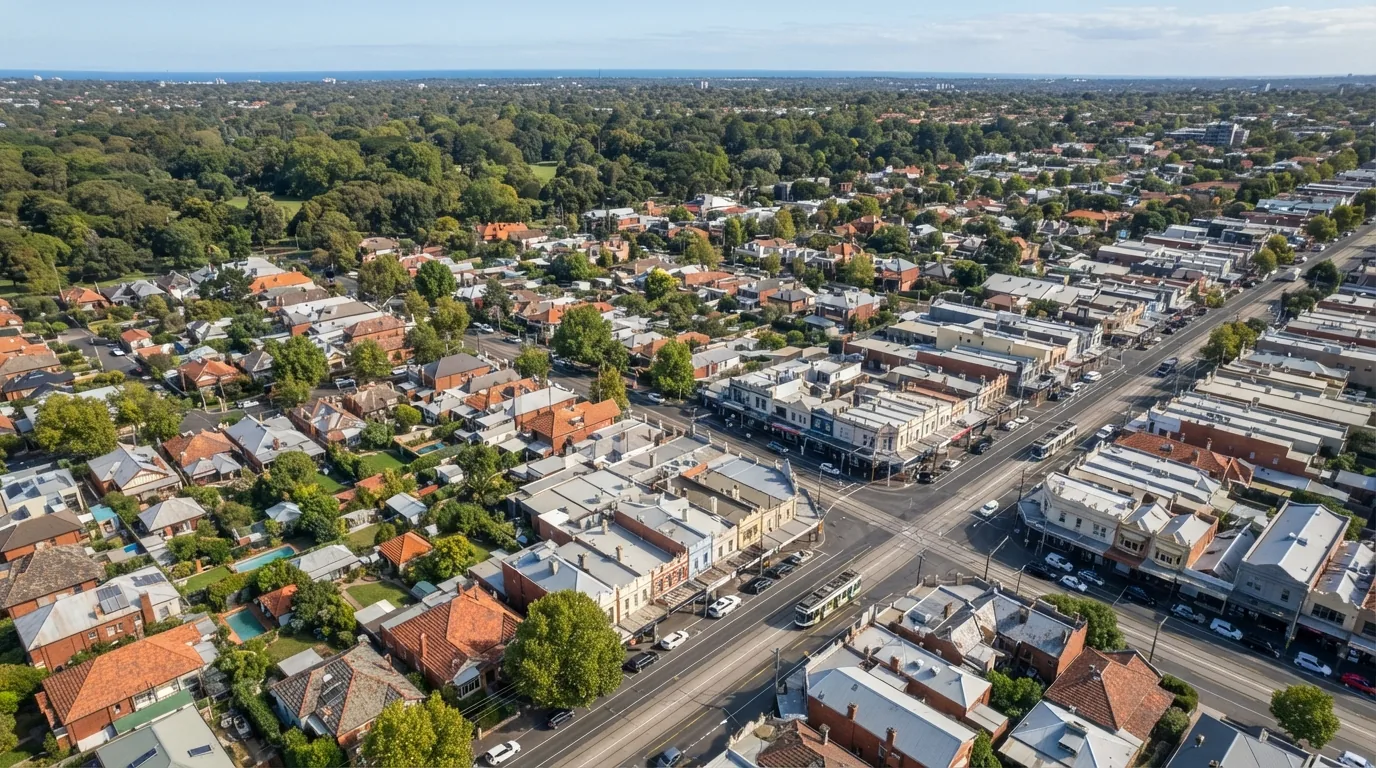
Painter in Camberwell, VIC
Camberwell, around the Junction
Camberwell has a lot of period houses and a lot of people who look after them. The streets out from Camberwell Junction, where Burke, Camberwell and Riversdale Roads meet, are lined with Edwardian houses, interwar homes and Californian bungalows, with apartments and newer townhouses closer to the shops. Painting here is often a careful exterior on a house the owners intend to keep, or a hallway and a set of front rooms done properly.
Close to the Junction, parking is time limited and the streets are busy, especially around the Sunday market, so a job there needs a driveway or an agreed place to park before the first morning. Further out, the streets are quieter and most houses have a side drive or path. Front gardens and hedges are part of most jobs, and they are tied back and covered before ladders go up.
The older houses are red brick or weatherboard with timber verandahs, bay windows, leadlight, gables and lath and plaster ceilings, while the bungalows have wide eaves, heavy porch piers and plaster ceilings. Many streets sit in heritage precincts, so painting a surface that has never been painted can need a council permit, and face brick is left as it is. Old paint on houses of this age may contain lead, which shapes how it is removed.
What we do here most
What Camberwell keeps needing
The work here is mostly about keeping a period house looking like itself, inside and out.
Exterior painting
A Californian bungalow front and porch repainted
Bungalows here have deep porches with heavy piers, wide eaves and a gable facing the street, and that is where the paint fails first. The eaves and gable timber are scraped and primed, cracks in the rendered piers are filled, and the front is painted in a scheme that suits the era of the house. Face brick stays unpainted.
Painting and restoration
Leadlight windows and frames on an Edwardian house
Edwardian houses here often have leadlight in the front windows and the door surround, set in timber frames that have cracked and flaked. The frames are repaired and painted by hand around the glass, with the leadlight protected throughout. Sills that have gone soft are replaced so the new paint has sound timber to sit on.
Walls and ceilings
Ceiling roses and cornices in the front rooms
The front rooms of period houses here often have a ceiling rose, a deep cornice and fine cracks running between them. Sound plaster is cut out and filled, gaps along the cornice are filled so the line runs straight, and the ceiling is painted by brush around the detail. Loose plaster is shown to you before any repair is quoted.
Interior painting
A hallway and staircase done before a sale
Houses near the Junction often come up for sale with a hallway that sets the tone for every inspection. The hall, the stairs and the front rooms are painted in the weeks before the photographs, in a neutral scheme the agent and you agree on. The days are planned backwards from the listing date.
If it is urgent
If water comes through a ceiling in a Camberwell house
- 1Look at the stain with a torch to see whether it is still spreading. Put a bucket under any drip, move furniture and rugs away, and switch off the power at the board for any light fitting near the water.
- 2Keep away from an old lath and plaster ceiling that is sagging or cracking around the wet patch, and do not pull at the cornice or rose. Leave the stain unpainted until the roof is fixed and the plaster has dried.
- 3When you call, tell us which room, whether the ceiling has a rose or ornate cornice, and whether the roof or box gutter has been repaired. Say whether the house is near the Junction and where we can park.
Common questions
Frequently Asked Questions
Which parts of Melbourne do you work in?
Melbourne's eastern and inner south-eastern suburbs, from Box Hill, Blackburn and Doncaster through Balwyn, Kew and Camberwell to Richmond, Toorak, Malvern, Prahran and Caulfield. All 25 suburbs are listed on the service areas page. If yours is not there, ask anyway, because the list is where the work goes most often rather than a fence.
Do you do plastering as well as painting?
Yes. Cracks, holes, water damaged patches and loose ceiling sheets are repaired and sanded before the paint goes on, so the repair and the painting are planned as one job rather than two trades working around each other. Most repaints in older houses need some of this, and it goes on the quote as its own line.
Can you fix rotten timber or a sticking door while you are here?
Yes, carpentry and fixing is one of the services, and it usually goes alongside the painting. Rotten weatherboards, soft window sills, loose skirting, sticking doors and broken fence palings are the common ones. Mention them when you call so they are in the quote rather than found on the day.
Do you do insurance repair work?
Yes. Painting and plaster repairs after a leak, a storm or an impact are one of the services. If you have a claim number or an assessor's report, send it with your enquiry and the quote is written against the same items, which makes the two easy to compare.
Do you give a written quote before starting?
Yes. You get it in writing before any paint is bought, listing the rooms or walls, the repairs, the preparation and the number of coats. If something changes once work starts, such as rot under a window sill, it is written down and you decide before it is done.
What do you need from me to quote?
Which rooms or which sides of the house, roughly how big they are, and a few photos taken in daylight. Point out anything flaking, cracked or stained, because preparation changes a quote more than size does. For outside work, say whether the house is single or double storey.
Can you help us choose colours?
We can talk through what tends to work on the house you have and how a colour behaves on that surface in that light. A sample patch on the actual wall is the most reliable way to decide, and it is worth doing before a full tin is bought. The final choice is always yours.
Do I need to move the furniture out first?
No, though clearing small and fragile things off shelves and walls helps. Larger furniture is moved to the middle of the room and covered, and floors are covered before anything is opened. Tell us about anything that cannot be moved, such as a piano or built in shelving.
What hours do you work?
Monday to Friday, 7:30am to 5:30pm. If you live in an apartment or a townhouse with set hours for trades, tell us when you call and the work days are planned inside them.
How long does a room or a house take?
It depends on the preparation more than the painting, so the honest answer comes with the quote rather than before it. A bedroom with sound walls is a different job from one with cracked plaster and a stained ceiling. Outside work also depends on the weather, because paint needs dry surfaces and mild days to go on well.
What happens if it rains during an outside job?
Work on the outside stops while the surfaces are wet, because paint put over damp timber or render does not hold. The day is moved rather than pushed through, and inside work can sometimes fill the gap. We let you know as soon as a day has to move.
Is old paint on an older house a problem?
It can be. Paint on houses built before the 1970s may contain lead, and that changes how it should be prepared, because dry sanding it spreads the dust. Tell us roughly when the house was built and we will talk it through before anything is quoted.
Everything we do here
Services in Camberwell, VIC
These are the eleven things we do across Melbourne, done here with the care that period houses and heritage streets need.
Also nearby
We work in these suburbs too
Local, and on the phone
Painting work in Camberwell
Call or email with the style of the house and whether the street is in a heritage precinct. Tell us where we can park, because near the Junction that decides the first morning.
0431 639 501Monday to Friday, 7:30am to 5:30pm
Not urgent? Send us the job instead